


I've been tracking the AI for chip design space for over a year, evaluating multiple companies in the sector. Normal Computing had the clearest lead. Today's Series B announcement confirms what drew us to them early.
Chip design is in crisis. Modern AI chips pack tens of billions of transistors, and getting a design to tape-out — the point where it's finalized for manufacturing — can cost more than $500 million before a single unit ships. Even small errors lead to expensive delays and rework that ripple across product roadmaps for the world's largest semiconductor companies and hyperscalers.
The incumbent EDA vendors have been trying to retrofit AI onto platforms that are decades old. It isn't working. The workflows are too complex, and the margin for error is effectively zero.
Normal Computing, founded in 2022 by former engineers and scientists from Google Brain, Google X, and Palantir, is pursuing a two-pronged bet on the future of AI hardware.
The first is a software platform that uses AI to help semiconductor companies design chips more efficiently — already in use at more than half of the top 10 semiconductor companies by revenue.
The second is longer-term: a new kind of processor built on a "thermodynamic" approach, using the inherent randomness of physical systems to compute more efficiently than traditional GPUs. The company has already taped out a prototype chip — an early but meaningful step toward reducing the energy demands of AI at scale.
As CEO Faris Sbahi put it: "The mission of the company is to go after the so-called AI energy crisis. Data centers are expected to hit an energy wall around 2030, and most of the strategy now is to find new ways to acquire more energy — but our position is to solve the problem in terms of the hardware that we're using."
"Normal Computing is solving one of the most expensive and underappreciated problems in AI infrastructure. Chip verification has been a bottleneck for decades, and the incumbents haven't cracked it. When Samsung and Micron are already paying customers and Samsung Catalyst is leading the Series B, that's the kind of enterprise validation that speaks for itself. We believe Normal has the team, the technology, and the strategic relationships to become a defining company in AI hardware infrastructure."
— Sam Awrabi, Founder & General Partner, Banyan Ventures
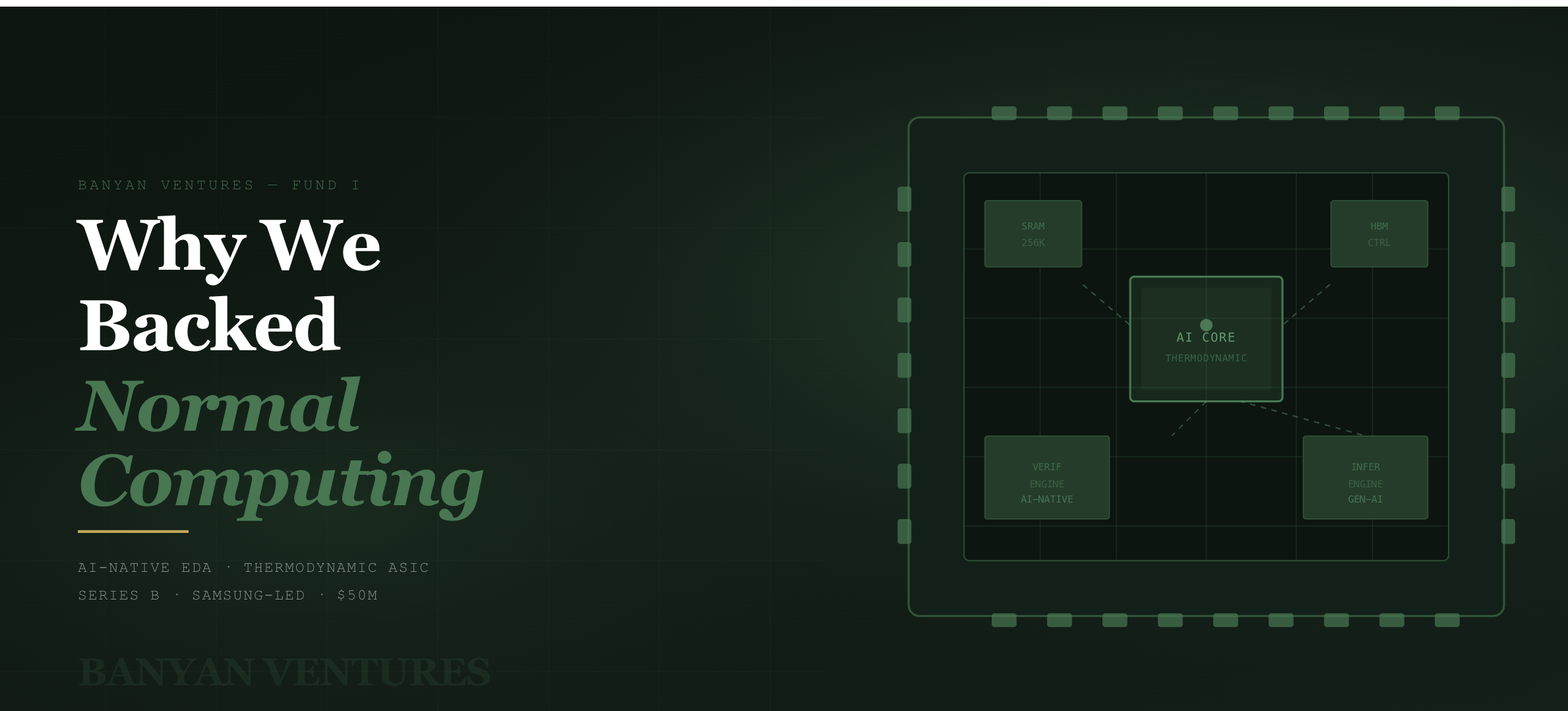
Normal Computing has closed a $50M Series B led by Samsung Catalyst. New investors include Galvanize, Brevan Howard Macro Venture Fund, and ArcTern Ventures. Existing backers Celesta Capital, Drive Capital, Eric Schmidt's First Spark Ventures, and Micron Ventures all participated.
The current fundraise will focus on scaling Normal's commercial software business, with the thermodynamic hardware effort continuing as a longer-horizon program.
Normal Computing sits at an important intersection: the rising cost and complexity of AI chip design, and the growing urgency around AI energy consumption. Their approach — working with existing chipmakers rather than trying to disrupt from the outside — is pragmatic and commercially grounded.
Banyan Ventures backs AI-native infrastructure companies at the pre-seed and seed stage. Normal Computing represents exactly the kind of deep technical, mission-driven team we look for: one solving a real, expensive problem for some of the most demanding customers in the world.
We're proud to be early backers and excited to watch this one develop.
Read the full Fortune coverage: [Normal Computing raises $50M from Samsung Catalyst — Fortune, March 25, 2026]
Portfolio Memo · AI Infrastructure · March 25, 2026
By Sam Awrabi, Founder & General Partner, Banyan Ventures

